Retired men, in particular, are spending long stretches of the day on smartphones. They scroll through WhatsApp forwards, watch political videos, consume sensational news clips, follow health advice from unverified sources, and pass along messages with conviction. In many households, this has become normal. It is even laughed off. The endless stream of “good morning” images and forwarded videos is treated as harmless. But it is no longer harmless. It is shaping opinions, fuelling fears, encouraging unhealthy routines and exposing older Indians to financial scams at an alarming scale.
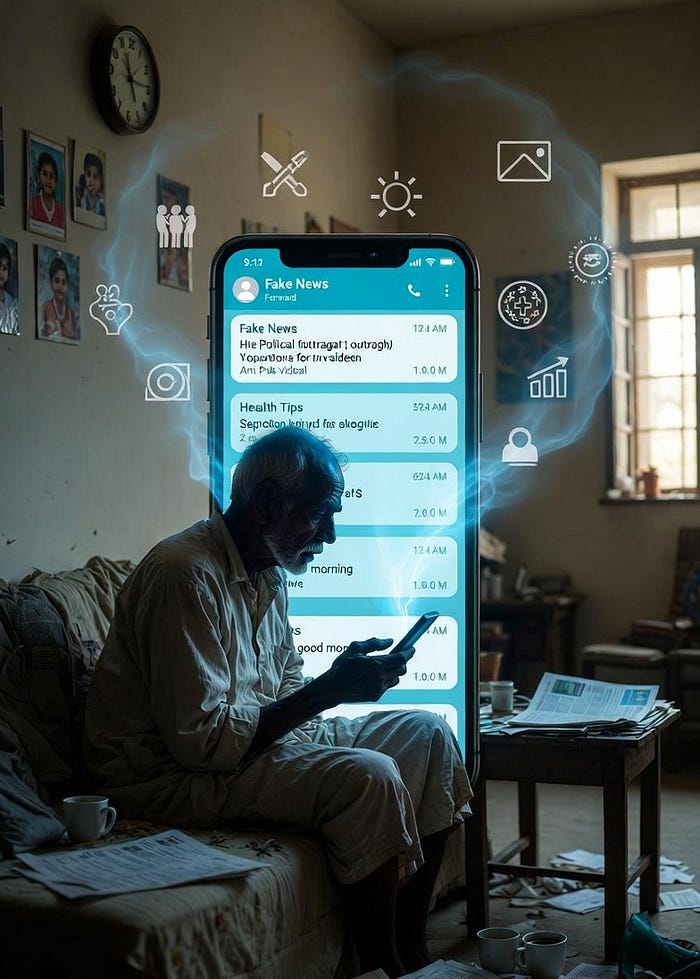
This shift deserves serious public attention. Older adults are not simply using phones for convenience. For many, the device has become a daily companion, a source of emotional stimulation, a substitute for conversation, and, in some cases, the main window through which they understand politics, society, and risk. That would be less worrying if the digital world rewarded accuracy and restraint. It does not. It rewards emotional reactions, repetition, outrage and trust without verification. In that environment, older users are especially exposed.
India’s ageing population adds to this problem. A recent study by researchers from NIMHANS and IIIT Bangalore noted that India had around 138 million older adults in 2021 and could cross 347 million by 2050. The same study, drawing on national ageing data, noted high levels of psychological distress, frequent loneliness and extremely low social participation among older adults. These are not background details. They help explain why smartphones become so powerful in later life. When daily structure weakens and isolation grows, the screen fills the gap.
The retirement scroll
The smartphone often enters old age as a practical tool. It helps people call family, share photos, join community groups, watch devotional content and access services. For children working in other cities, it can be reassuring to know that parents are digitally connected. In moderation, that is true. Technology can help older adults stay informed and less isolated. But in India, moderation is often not the story.
A News18 survey, based on 2,002 urban Indians aged 55 and above, found that more than 76.9 per cent used smartphones. Nearly 77 per cent used them for messaging and chatting, while over 78 per cent used platforms such as WhatsApp, FaceTime and Telegram to stay connected. This is a major behavioural shift. It means the digital life of older Indians is now central, not peripheral.

The more detailed problem is not just smartphone use, but the concentration of that use. In the NIMHANS study on older adults and digital platforms, 17 of 19 participants reported using WhatsApp daily. Their reported screen time ranged from 1 to 5 hours a day, with some crossing 8 hours. The reasons were familiar. They used phones to pass the time, fight boredom, stay in touch, watch videos, gather health information and manage loneliness. In other words, the phone was not merely a device. It had become part of the emotional rhythm of the day.
This is where retirement changes the equation. Children and working adults live within schedules. School, work, commuting, and deadlines create boundaries around screen use. Retired life often has fewer fixed structures. That can be liberating, but it can also open a large empty space. The smartphone slips into that space with ease. It offers novelty, opinion, excitement and constant contact. It requires little effort and offers quick psychological rewards. That is precisely why high screen time in old age can become so deeply entrenched.
When connection turns into dependence
Families often assume that if an older person is chatting, watching videos or forwarding messages, they must be socially engaged. But digital contact is not always equivalent to a meaningful social connection. In fact, one can increase while the other declines.
The same Indian study showed that older adults valued physical activity, social connectedness and purposeful engagement as important to mental well-being. Yet many also spent long hours online. This creates a troubling contradiction. The screen appears to ease loneliness, but it can quietly replace the activities that genuinely reduce it, such as walking with neighbours, visiting friends, attending community gatherings, engaging in hobbies or simply sitting with family without a device in hand.
The result is a form of shallow connection. A person may receive dozens of messages each day and still feel alone. They may appear busy while growing more sedentary and socially withdrawn. Digital engagement can become a comforting habit without offering the deeper psychological benefits of real companionship. That matters in older age, when bereavement, retirement, reduced mobility and shrinking social circles already make emotional resilience harder to maintain.
The NIMHANS research also found signs of psychological strain among participants. Seven of the 19 older adults showed mild psychological distress, while four had moderate to severe distress on the PHQ-4 screening measure. This is not a national prevalence estimate, and it should not be treated as one. But it is an important warning sign. It suggests that digital overuse in later life is unfolding alongside anxiety, loneliness and emotional vulnerability, not separately from them.
The body pays too: impact on health
The dangers of high screen time are often discussed in terms of ideas, beliefs and misinformation. But the body pays a price, too.
Long hours on a phone usually mean long hours sitting still. For older adults, that is significant. Reduced movement can worsen existing problems such as stiffness, poor balance, diabetes, obesity, poor sleep and cardiovascular risk. It can also weaken the mood. A day filled with digital content may feel active in the mind, but physically, it is often a day of very little movement.

Sleep is another casualty. The Indian study found that improving sleep was one of the top priorities identified by participants. This is revealing. It shows that older adults themselves recognise sleep as a fragile part of health. Yet the patterns of smartphone use often work directly against it. Many people scroll late into the night, watch emotionally arousing videos, or keep their phones by the bed, where notifications continue to interrupt rest. Fear-inducing health claims, crime clips, and political rumours can also leave the mind agitated long after the screen is switched off.
For older adults, sleep loss has wider consequences than mere tiredness. It can affect blood pressure, concentration, memory, mood and daytime confidence. In later life, poor sleep and emotional strain often reinforce each other. The more anxious a person becomes, the more they turn to the phone for distraction or reassurance. The more they use the phone, the harder it may become to rest well.
WhatsApp and the collapse of verification
No discussion of this issue in India is complete without WhatsApp. It is the central platform through which many older adults receive information. Its appeal is obvious. It is easy to use, familiar, social and immediate. It feels private and trustworthy because messages come from known people.
That sense of trust is exactly what makes it dangerous.
The NIMHANS study noted that India has about 535.8 million WhatsApp users and that it is the country’s most widely used social platform, with 83 per cent of internet users using it. Among older adults, the app often becomes the first stop in the morning and the last stop at night. Messages come from family, former colleagues, school friends, society groups, temple circles and neighbourhood associations. Each message arrives wrapped in social familiarity. That familiarity lowers scepticism.

Older users are not alone in believing false information, but they may be more exposed to it and more likely to receive it in emotionally persuasive forms. A report highlighted by SSRC’s MediaWell, drawing on reporting from The Wire, described how elderly users in India were flooded with false or misleading claims during the COVID period, including fake remedies and inaccurate health advice. One older man admitted that repeated exposure left him unable to tell what was true and what was false. That confusion is one of the deepest harms of misinformation. It does not just implant one lie. It weakens confidence in the very process of judging truth.
Repeated forwards also create a false sense of legitimacy. If the same claim appears in five groups, many assume it must have some basis. In reality, repetition often reflects coordination rather than credibility. But for older adults, especially those who grew up in a media culture where publication itself signalled reliability, this distinction is not always obvious.
The political use of older attention
This problem becomes even more serious when politics enters the frame.
WhatsApp has been widely documented as a powerful tool in Indian election campaigns. TIME reported before the 2019 general election that political parties were building large WhatsApp networks and using personal data, including age, location and religion, to send tailored political messaging to specific groups. The report described how users could be sorted into categories based on what they were likely to respond to, making persuasion more precise and more emotionally effective.
The BBC similarly reported that both major national parties were relying on WhatsApp networks during the election and that the platform had become a “black hole” for fake news in India. This mattered not only because false claims spread quickly, but because closed messaging groups made them harder to track, challenge and correct.

Older people are especially relevant here. Retired men often follow public affairs closely. They may spend more time discussing politics than younger family members. They may also hold moral authority within the family, making their opinions influential beyond their personal screen habits. A politically loaded falsehood believed by one elder can shape the views of children, relatives and neighbours. In that sense, older adults are not just victims of digital propaganda. They can become its unpaid distributors.
To be fair, India still lacks enough age-specific academic research that isolates older adults as a separate target group in political disinformation campaigns. That gap should be stated clearly. But the broader pattern is visible. Political actors use demographic segmentation. WhatsApp is central to message distribution. Older adults are among its most consistent users. The line from targeted messaging to opinion formation is not hard to draw.
Fraud in the age of trust
If political misinformation exploits belief, digital fraud exploits trust.
Senior citizens have become prime targets for online crime in India. The reasons are straightforward. Many have retirement savings or pensions. Many are polite and responsive to authority. Some are still learning the basics of app interfaces, digital payments, and privacy settings. Many also feel embarrassed asking younger relatives for help. Fraudsters understand all of this. They tailor their scripts accordingly.
Official data from the Government of India shows the scale of cybercrime overall. NCRB figures cited by the Ministry of Home Affairs showed that cybercrime cases rose from 27,248 in 2018 to 65,893 in 2022. The government has also stated that age-specific NCRB data for elderly victims are not maintained separately. That absence of detailed national data is itself a policy weakness. It leaves the country without a clear official picture of how deeply seniors are being hit.
Still, survey-based findings and case reports point in the same direction. Reporting on a Safer Internet India assessment said cybercrimes targeting seniors rose by 86 per cent between 2020 and 2022. The same report said 45 per cent of Indian seniors struggled to identify online fraud. Many also found app interfaces difficult to understand. These are not complete national crime figures, but they show clear vulnerability.

The frauds themselves are increasingly sophisticated. They include fake bank alerts, bogus KYC updates, investment scams, impersonation of police or regulators, and the now infamous “digital arrest” scam, in which criminals terrorise victims by pretending they are involved in legal trouble. In one widely reported case, an elderly Delhi couple allegedly lost around Rs 14 crore after being manipulated by fraudsters posing as officials. Such crimes depend on fear, obedience and prolonged psychological pressure.
The NIMHANS study again brings the issue down to a human level. One participant spoke of losing five to six lakhs after being trapped in an online scam. The financial damage was severe, but so was the emotional damage. Shame often follows fraud. Many victims do not report the crime quickly because they fear blame or humiliation. This silence allows the problem to grow.
A problem families can no longer laugh away
The smartphone is not the enemy. Isolation is. Boredom is. Misinformation is. Manipulation is. But the smartphone is the delivery system through which all of these forces now reach millions of older Indians every day.
There is a habit in many families of laughing at older people’s digital behaviour. The endless forwards. The dramatic rumours. The bad medical advice. The loud political videos. The accidental taps. The gullibility. But beneath that humour is a social, emotional, and deeply national problem.
The old image of the elder as a wise gatekeeper of information is eroding in a digital environment built to exploit attention and trust. That is not a moral failure of older people. It is a failure of preparation. India brought millions of older adults into the smartphone era without giving them the tools to defend themselves against its worst features.
What is needed now is not panic, but seriousness. Families should respond with patience rather than ridicule. Public campaigns should be designed specifically for seniors, in regional languages and in plain speech. Banks, resident associations, clinics and community organisations should treat digital literacy and scam awareness as basic elder care. And public debate must stop framing screen risk as a children’s issue alone.
The phone in an older person’s hand can still be a tool of connection, comfort and usefulness. But only if we acknowledge the danger of leaving that hand unsupported in a digital world that profits from confusion. India’s older people do not need lectures about being “too online”. They need protection, better habits, and a digital culture that does not treat their trust as prey.
Sources
- NIMHANS and IIIT Bangalore, “Engagement with digital platforms and perspectives on WhatsApp based mental health self-help solution for older adults”
https://pmc.ncbi.nlm.nih.gov/articles/PMC12381335/ - Ministry of Home Affairs, Government of India, Lok Sabha reply on cyber crimes targeting elderly people
https://www.pib.gov.in/PressReleasePage.aspx?PRID=2146786 - News18, “Boomers are More Tech-savvy Than You Think: 77% Indians Over 60 Prefer Texting, WhatsApp and Facebook Over Calls”
https://www.news18.com/news/buzz/boomers-are-tech-savvier-than-you-think-77-indians-over-60-prefer-texting-whatsapp-and-facebook-over-calls-3310303.html - TIME, “How WhatsApp Is Fueling Fake News Ahead of India’s Elections”
https://time.com/5512032/whatsapp-india-election-2019/ - BBC, “WhatsApp: The ‘black hole’ of fake news in India’s election”
https://www.bbc.com/news/world-asia-india-47797151 - SSRC MediaWell citing The Wire, “Why the Elderly Are More Susceptible to Social Media Misinformation”
https://mediawell.ssrc.org/news-items/why-the-elderly-are-more-susceptible-to-social-media-misinformation-the-wire/ - Storyboard18, “45% of Indian seniors struggle to identify online fraud”
https://www.storyboard18.com/digital/45-of-indian-seniors-struggle-to-identify-online-fraud-cybercrimes-on-the-rise-58331.htm - Safer Internet India, “Understanding Senior Citizens’ Experience with Online Fraud”
https://saferinternetindia.com/wp-content/uploads/2025/03/Digital_Understanding-Senior-Citizens-Experience-with-Online-Fraud-A-Survey-Based-Assessment.pdf - Indian Express, “Why senior citizens in India are prime targets for cybercrime”
https://indianexpress.com/article/technology/senior-citizens-in-india-are-prime-targets-for-cybercrime-how-to-stay-safe-10218480/


0 comments:
Post a Comment